Tradition
Etawah
Ustad
Vilayat Khan
Notable Students
Click highlighted names to view their profiles
Biography
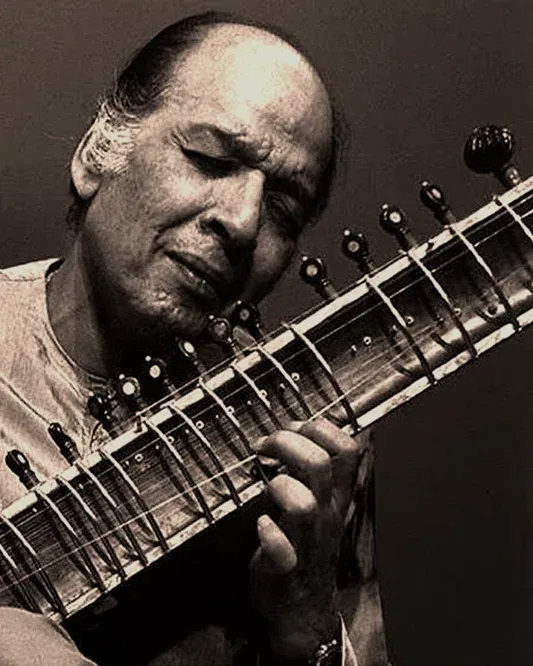
Ustad Vilayat Khan (28 August 1928 - 13 March 2004) was an Indian classical sitar player, considered by many to be the greatest sitarist of his age. Born in Gouripur, Mymensingh in East Bengal (present-day Bangladesh), he was the eldest son of Ustad Enayat Khan, one of India's most influential sitar and surbahar players, and grandson of the legendary Ustad Imdad Khan who founded the Imdadkhani gharana.
He began rigorous training under his father Enayat Khan early on, developing a deep immersion in the guru-shishya tradition. After the untimely death of his father in 1938, when Vilayat was only ten, his musical education continued under his uncle Wahid Khan, his maternal relatives, and his mother Bashiran Begum. He recorded his first 78-RPM disc at the age of eight and was probably the first Indian musician to play in England after independence in 1951.
Vilayat Khan is most celebrated for his development and perfection of the gayaki ang style on the sitar, a revolutionary technique that emulates the vocal melisma of Hindustani classical music, making the sitar seem to sing. He invented a technique of bending a note after the sitar string was plucked, creating an unprecedented sound quality. He also composed music for several acclaimed films, including Satyajit Ray's Jalsaghar (1958) and The Guru (1969).
His career spanned over six decades, giving his last concert in 2004 at the age of 75. In a remarkable display of artistic integrity, he refused India's Padma Shri (1964), Padma Bhushan (1968), and Padma Vibhushan (2000), declaring the committees musically incompetent to judge him. The only titles he accepted were "Bharat Sitar Samrat" from the Artistes Association of India and "Aftab-e-Sitar" (Sun of the Sitar) from President Fakhruddin Ali Ahmed. His brother Ustad Imrat Khan and sons Shujaat Khan and Hidayat Khan continue the Imdadkhani legacy.
Profile last updated 2026-10-09
See something wrong? Suggest a correction