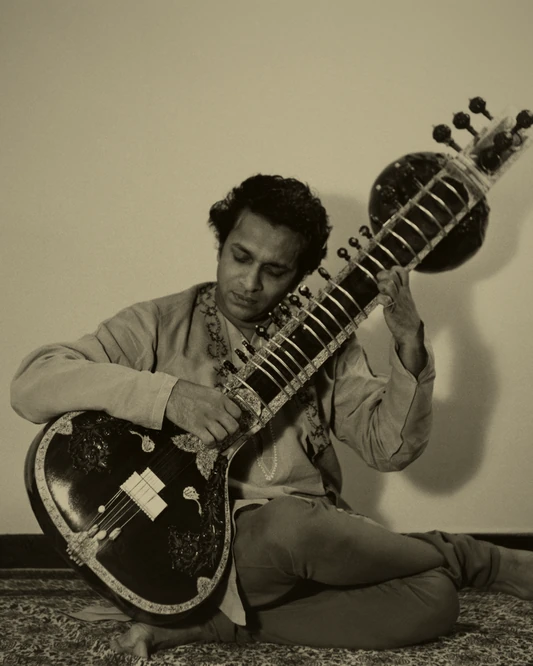
Pandit
Ravi Shankar
- Instrument
- Sitar
- Gharana
- Maihar
- Lived
- 1920 to 2012
Biography
Born into a Bengali Brahmin family, Shankar spent most of his youth studying music and dance and touring extensively in India and Europe with his elder brother Uday Shankar's dance troupe. At age 18 Shankar gave up dancing, and for the next seven years he studied the sitar under a noted musician gharana. After completing his training as a sitar artist in the mid-1940s, Shankar joined the Indian People's Theatre Association, a left-wing theatrical organization that promoted ideals of social and economic equality. He composed music for the group's productions and recomposed the popular patriotic song "Saare Jahan Se Accha"; his version remains the one most commonly performed and is frequently used by the Indian Army as a marching song. Shankar served as music director of All India Radio (AIR) from 1948 until 1956, during which time he founded the Indian stint at AIR and began a series of European and American tours. Shankar composed 31 ragas, including Bairagi, Rasiya, and Banjara. He composed film scores for Neecha Nagar (1946), the acclaimed Apu trilogy (1955–59) by Satyajit Ray, and Gandhi directed by Richard Attenborough. In 1962 he founded the Kinnara School of Music in Bombay and established a second Kinnara School in Los Angeles in 1967.
Watch and read
More in Explore ›My Music, My Life
Ravi Shankar · 1968
Ravi Shankar's memoir, which also explains how the music works.
Indian Sun
Oliver Craske · 2020
The first full biography of Ravi Shankar, from more than 130 interviews.
The Dawn of Indian Music in the West
Peter Lavezzoli · 2006
How the music reached America, starting with Ali Akbar Khan's 1955 concert at MoMA.
As an Amazon Associate, SangeetCentral earns from qualifying purchases.
Profile last updated 2026-09-23
See something wrong? Suggest a correction