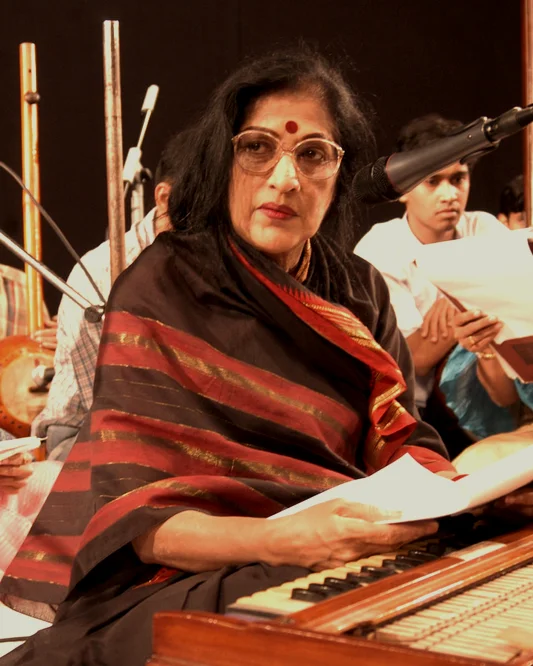
Vidushi
Kishori Amonkar
- Instrument
- Vocal
- Gharana
- Jaipur-Atrauli
- Guru
- Mogubai Kurdikar
- Lived
- 1932 to 2017
- From
- Bombay, British Raj, India
Notable Students
Click highlighted names to view their profiles
Biography
Kishori Amonkar (10 April 1932 – 3 April 2017) was one of the most influential Hindustani classical vocalists of the twentieth century, a towering figure of the Jaipur-Atrauli gharana whose art redefined the boundaries of tradition. Born in Bombay, she was the daughter of Mogubai Kurdikar, herself a distinguished vocalist of the Jaipur gharana, who served as Kishori's primary guru through an exacting pedagogy of phrase repetition and concert accompaniment on the tanpura.
In the early 1940s, Amonkar broadened her training by studying with masters from multiple gharanas: Anjanibai Malpekar of the Bhendibazaar gharana, who taught her the crucial technique of meend (gliding between notes); Anwar Hussain Khan of the Agra gharana; and Sharadchandra Arolkar of the Gwalior gharana. This multi-gharana education proved foundational to her later innovations and her conviction that music transcends the boundaries of any single school.
Amonkar's musical philosophy was radical for its time. She famously declared, "There is nothing called a gharana. There is only music." While maintaining the Jaipur-Atrauli foundation, she adopted alapchaari — relaxing the rhythm-note connection — and incorporated expressive elements from other traditions, prioritizing emotional depth over rigid structural convention. A period of illness that affected her vocal capacity became, paradoxically, a creative catalyst, as she used the hiatus to develop her distinctive style that transcended traditional gharana limitations.
Her mastery spanned the classical genre of khayal and the lighter forms of thumri and bhajan, all rendered with what peers described as profound emotional depth and spiritual intensity. She viewed music not as entertainment but as sadhana — spiritual practice — leading to sadhya, the ultimate destination. "To me it is a dialogue with the divine," she said, "this intense focused communication with the ultimate other." This spiritual dimension permeated every performance, and she was known for her pre-concert seclusion and her insistence that "the audience cannot disturb the loneliness of an artiste."
Amonkar received India's highest civilian honors for her contributions: the Sangeet Natak Akademi Award (1985), the Padma Bhushan (1987), the Padma Vibhushan (2002), the Sangeet Natak Akademi Fellowship (2009), and the M.S. Subbulakshmi Award (2016). She also briefly ventured into film, singing playback for Geet Gaya Patharon Ne (1964), though she discontinued cinema work, finding it compromised the integrity of the swaras.
Her teaching lineage extended her influence across generations. Among her notable disciples are Manik Bhide, Raghunandan Panshikar, Arati Ankalikar-Tikekar, Devaki Pandit, and Manjiri Asnare-Kelkar, each of whom achieved independent distinction while carrying forward her emotive, exploratory methodology. Her granddaughter Tejashree also trained under her guidance.
Tabla maestro Zakir Hussain described her concerts as "landmark performances that take place over hundreds of years and you will talk about them for the rest of your life and rest of the many centuries to come." Carnatic vocalist T.M. Krishna noted that "when Kishoriji sings she is not trying to be new but just by being with her music and continuing to submit to it, she has given classical music an everlasting newness and freshness." She published Swaraartha Ramani (2010) in Marathi, elaborating her views on musical theory and practice, and was the subject of the documentary Bhinna Shadja by Amol Palekar and Sandhya Gokhale.
Kishori Amonkar passed away on 3 April 2017 in Mumbai at the age of 84, leaving behind a legacy that permanently expanded the expressive possibilities of Hindustani classical music.
Watch and read
More in Explore ›Bhinna Shadja
FreeAmol Palekar and Sandhya Gokhale · 2011
Kishori Amonkar in her own words, commissioned by India's Ministry of External Affairs.
Hear the Hindustani tradition live
See all ›Profile last updated 2026-10-09
See something wrong? Suggest a correction