Tradition
Maihar
Ustad
Ali Akbar Khan
Notable Students
Click highlighted names to view their profiles
Biography
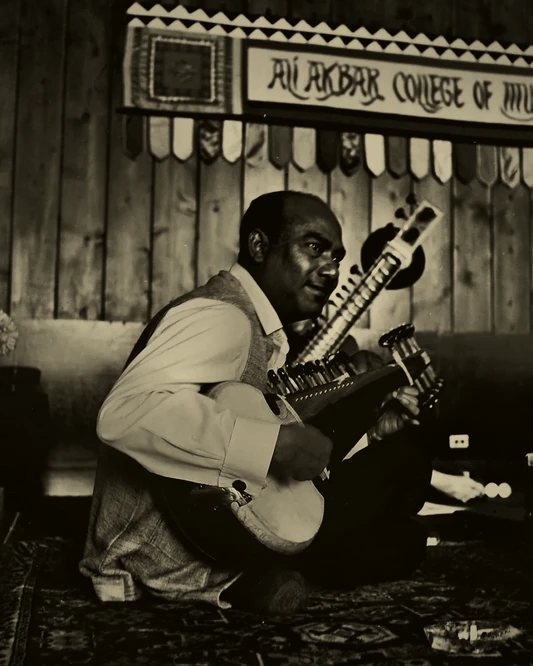
Ustad Ali Akbar Khan (14 April 1922 - 18 June 2009) was an Indian Hindustani classical musician of the Maihar gharana, widely regarded as one of the greatest sarod players in the history of Indian music. Born in Shibpur, Brahmanbaria (present-day Bangladesh), he was the son of the legendary multi-instrumentalist and teacher Ustad Allauddin Khan, who was also the founder of the Maihar gharana.
From an early age, Khan received intensive training from his father in various instruments as well as vocal composition, ultimately gravitating towards the sarod. Allauddin Khan was a perfectionist and strict taskmaster, and Khan's lessons often started before dawn and lasted up to 18 hours a day. He gave his debut performance at a music conference in Allahabad in 1936 at the age of 13, and in 1943 was appointed a court musician for the Maharaja of Jodhpur, Umaid Singh.
Khan first came to America in 1955 on the invitation of violinist Yehudi Menuhin and later settled in California. He established a music school in Calcutta in 1956 and founded the Ali Akbar College of Music (AACM) in 1967, which moved with him to the United States and is now based in San Rafael, California. He was instrumental in popularizing Indian classical music in the West, both as a performer and as a teacher.
His numerous honors include the Padma Bhushan (1967), Padma Vibhushan (1989), the MacArthur Fellowship (1991) - the first Indian musician to receive this so-called "genius grant" - and the National Heritage Fellowship from the National Endowment for the Arts (1997), the highest honor in the traditional arts in the United States. He also composed several film scores and recorded extensively. His children include sarod players Aashish Khan, Alam Khan, and Manik Khan, who continue the Maihar gharana legacy.
Hear the Hindustani tradition live
See all ›Profile last updated 2026-10-09
See something wrong? Suggest a correction